
Founder’s Note
Practise grammar until the form comes to mind
Edited from founder interviews
I can explain a grammar rule and still pause in conversation. In Japanese, it happens even with small things: do I need da before yo here? The rule is simple enough. I need it at the right moment.
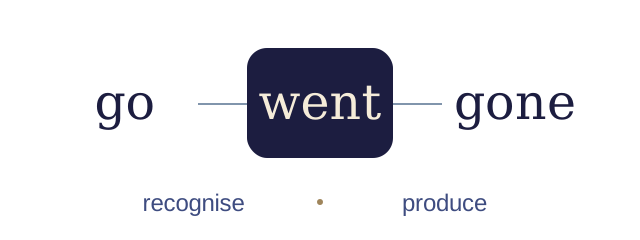
Understanding a rule is not producing a form
With go, went, gone, the relationship is hard to see. Many Japanese forms are more regular, but past, negative and passive forms soon add up. I may understand each rule and still struggle when they combine.
I want to enter the form myself and see right away whether it is correct. After a mistake, my answer should sit beside the correct one, so I can see what to change.
Practise with words you know
When both the word and the rule are new, a wrong answer is hard to interpret. Did I miss the meaning or the form?
For form practice, the words and rules should already have been introduced. Now I apply them across different words I know. Reusing the same two sample verbs gets dull quickly.
Correct, but still hesitant
A correct answer can still take effort. Did I work it out step by step, or did it come straight away?
Response time offers a clue, but it includes reading, typing and corrections. The website example therefore shows the time before the first input separately from the time spent typing. Neither number alone tells us whether you have mastered a form.
Learning still takes work
Learning a language is hard work. Reviewing words, making a form yourself, reading a difficult sentence again: that is part of it. will not teach you a language in your sleep either.
I would rather spend my time doing that than sorting my vocabulary all over again when I switch apps. That is where I want to help. I still have to practise myself.
Research
Two findings matter when designing this kind of practice:
Mixing grammar forms
In a study with 115 Japanese learners of English, mixed practice of five grammar structures led to better results on a grammar test a week later than practising each in a block, despite more errors during practice.
The test measured judgements about sentences, not free speaking.
Nakata & Suzuki (2019): Mixing Grammar Exercises Facilitates Long-Term Retention: Effects of Blocking, Interleaving, and Increasing Practice ↗Spacing reviews
A meta-analysis of 48 experiments supports spaced practice in language learning. On later tests, longer intervals tended to work better than shorter ones.
This does not give us one ideal schedule for every learner and task.
Kim & Webb (2022): The Effects of Spaced Practice on Second Language Learning: A Meta-Analysis ↗
These studies inform anuno’s design. The effect of this specific implementation still needs to be studied.